
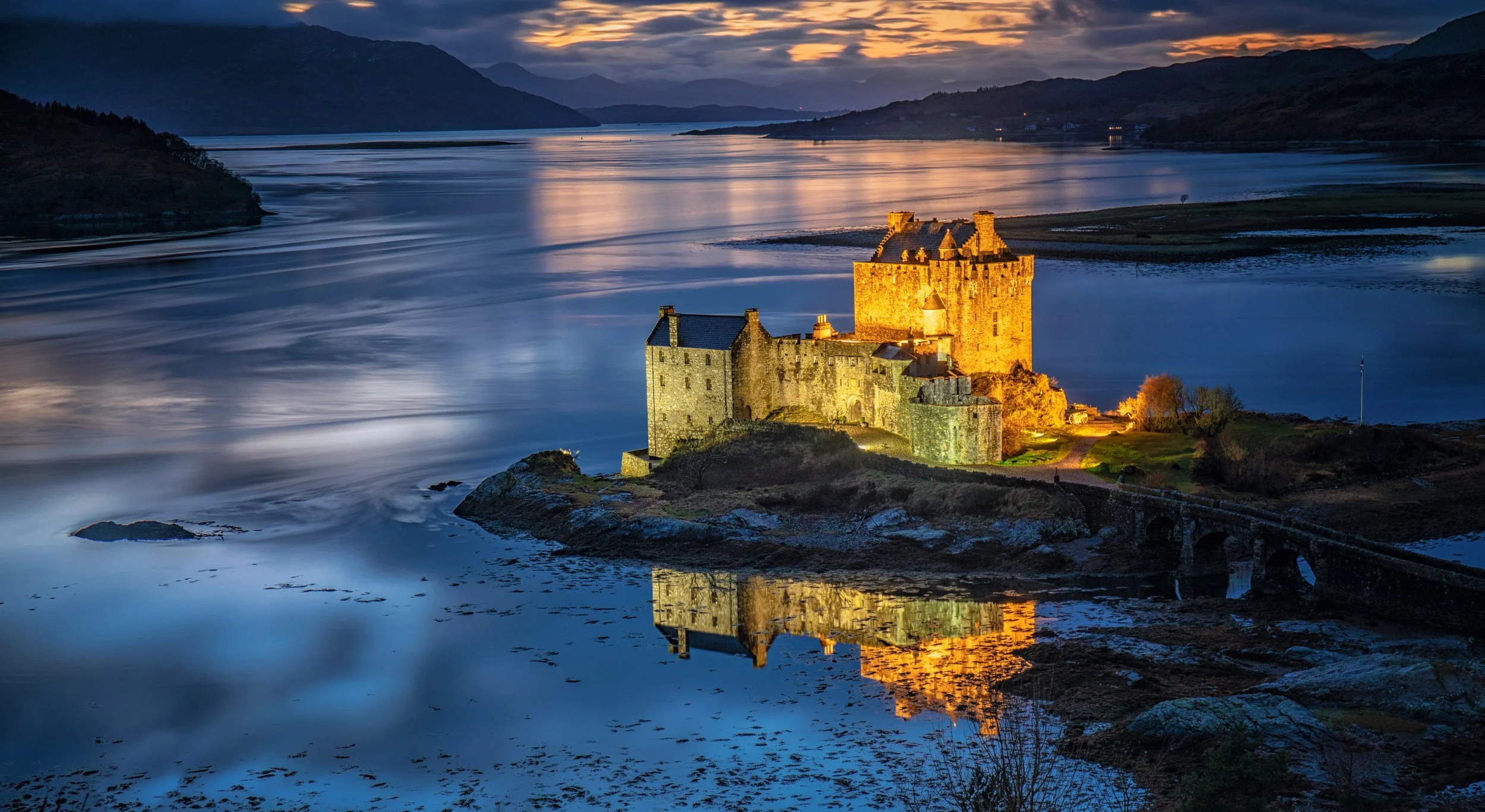
Eilean Donan Castle stands on a small tidal island at the meeting point of Loch Duich, Loch Long and Loch Alsh, near Dornie in the Western Highlands, and has become one of the most instantly recognisable images of Scotland worldwide. Originally built in the 13th century to help defend the lands of Kintail against Norse raids, it later became closely associated with Clan Mackenzie and Clan MacRae before being partially destroyed during the Jacobite risings and lying in ruins for nearly two centuries. In the early 20th century Lieutenant Colonel John MacRae-Gilstrap painstakingly restored the castle, reopening it in 1932, and its stone bridge, island setting and mountainous backdrop now draw photographers and filmmakers from around the globe. This photograph takes this classic, heavily photographed subject and imposes a unique vision on it: the way the balance of the castle rises against the surrounding hills, uses the bridge or shoreline as a leading line, and controls light and reflection turning a familiar postcard view into something atmospheric and personal, demonstrating both strong technical craft and a clear artistic voice in one of Scotland’s most demanding “icon” locations.
Eilean Donan Castle stands on a small tidal island at the meeting point of Loch Duich, Loch Long and Loch Alsh, near Dornie in the Western Highlands, and has become one of the most instantly recognisable images of Scotland worldwide. Originally built in the 13th century to help defend the lands of Kintail against Norse raids, it later became closely associated with Clan Mackenzie and Clan MacRae before being partially destroyed during the Jacobite risings and lying in ruins for nearly two centuries. In the early 20th century Lieutenant Colonel John MacRae-Gilstrap painstakingly restored the castle, reopening it in 1932, and its stone bridge, island setting and mountainous backdrop now draw photographers and filmmakers from around the globe. This photograph takes this classic, heavily photographed subject and imposes a unique vision on it: the way the balance of the castle rises against the surrounding hills, uses the bridge or shoreline as a leading line, and controls light and reflection turning a familiar postcard view into something atmospheric and personal, demonstrating both strong technical craft and a clear artistic voice in one of Scotland’s most demanding “icon” locations.