
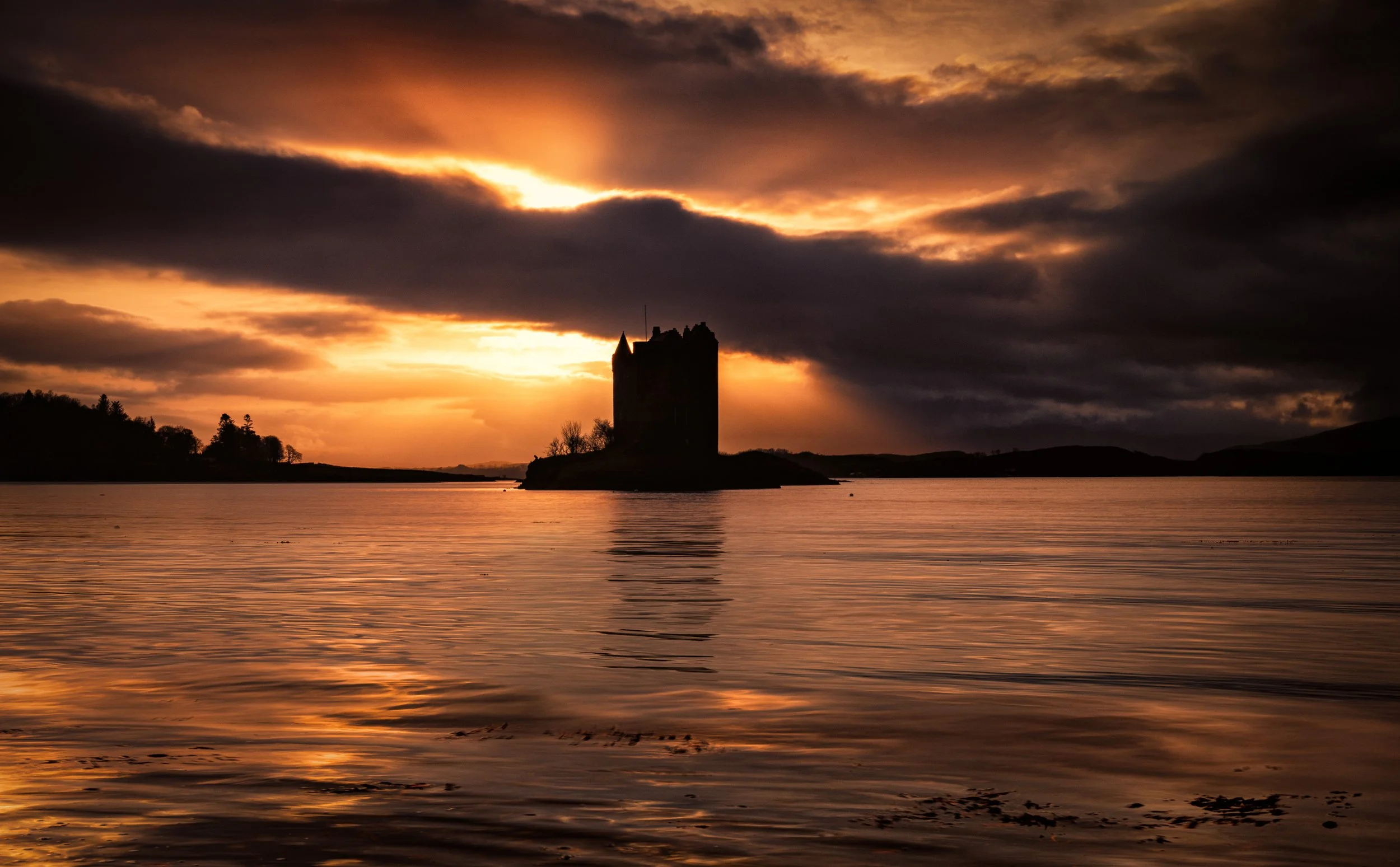
Castle Stalker is a striking four-storey medieval tower house set on a tiny tidal islet in Loch Laich, off Loch Linnhe, near Port Appin on Scotland’s west coast. Its Gaelic name, Caisteal an Stalcaire, meaning “castle of the hunter” or “falconer,” reflects its historic use as a hunting retreat for Scottish nobility. The site was first fortified by the MacDougalls in the early 14th century, but the castle as seen today was largely built around the mid-15th century by the Stewarts of Appin and later passed, amid clan rivalries and even a drunken wager, to the Campbells. Abandoned in the 19th century and left roofless, it was painstakingly restored in the 20th century and now stands as one of Scotland’s best-preserved and most photogenic tower houses, familiar to many from its appearance as the “Castle of Aaargh” in Monty Python and the Holy Grail.
Castle Stalker is a striking four-storey medieval tower house set on a tiny tidal islet in Loch Laich, off Loch Linnhe, near Port Appin on Scotland’s west coast. Its Gaelic name, Caisteal an Stalcaire, meaning “castle of the hunter” or “falconer,” reflects its historic use as a hunting retreat for Scottish nobility. The site was first fortified by the MacDougalls in the early 14th century, but the castle as seen today was largely built around the mid-15th century by the Stewarts of Appin and later passed, amid clan rivalries and even a drunken wager, to the Campbells. Abandoned in the 19th century and left roofless, it was painstakingly restored in the 20th century and now stands as one of Scotland’s best-preserved and most photogenic tower houses, familiar to many from its appearance as the “Castle of Aaargh” in Monty Python and the Holy Grail.