
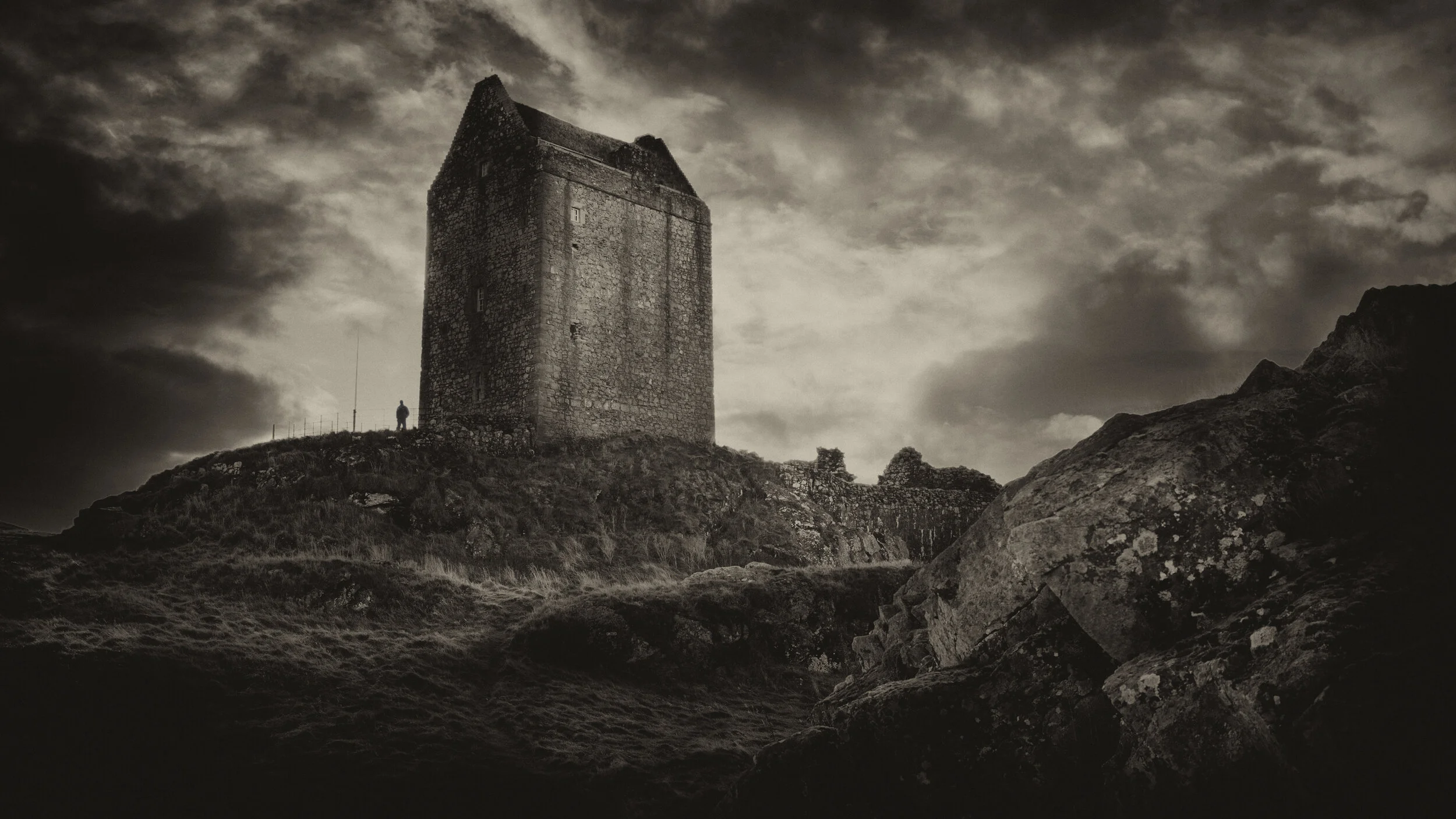
Hermitage Castle broods over the lonely moorland of Liddesdale in the Scottish Borders, a massive H‑plan fortress of dark stone whose hulking walls have earned it a reputation as the “guardhouse of the bloodiest valley in Britain.” Probably founded in the 1240s near the English border, it became a vital stronghold during the Wars of Independence and the long centuries of border conflict, repeatedly changing hands between Scottish and English lords as power shifted. Its later form, developed from the mid‑14th century, combines a central hall block with four corner towers, creating an austere yet imposing residence for powerful families such as the de Soules, Douglas, and later the Scotts of Buccleuch. Dark legends of murder, torture, and witchcraft cling to its story, while its most famous episode came in 1566 when Mary, Queen of Scots undertook a perilous ride from Jedburgh to visit the wounded James Hepburn, Earl of Bothwell, within its walls. Abandoned after the Union of the Crowns in 1603, Hermitage fell into ruin, but its stark silhouette and bloody history still exert a powerful pull on visitors, standing as one of the most atmospheric and evocative ruined castles in Scotland.
Hermitage Castle broods over the lonely moorland of Liddesdale in the Scottish Borders, a massive H‑plan fortress of dark stone whose hulking walls have earned it a reputation as the “guardhouse of the bloodiest valley in Britain.” Probably founded in the 1240s near the English border, it became a vital stronghold during the Wars of Independence and the long centuries of border conflict, repeatedly changing hands between Scottish and English lords as power shifted. Its later form, developed from the mid‑14th century, combines a central hall block with four corner towers, creating an austere yet imposing residence for powerful families such as the de Soules, Douglas, and later the Scotts of Buccleuch. Dark legends of murder, torture, and witchcraft cling to its story, while its most famous episode came in 1566 when Mary, Queen of Scots undertook a perilous ride from Jedburgh to visit the wounded James Hepburn, Earl of Bothwell, within its walls. Abandoned after the Union of the Crowns in 1603, Hermitage fell into ruin, but its stark silhouette and bloody history still exert a powerful pull on visitors, standing as one of the most atmospheric and evocative ruined castles in Scotland.